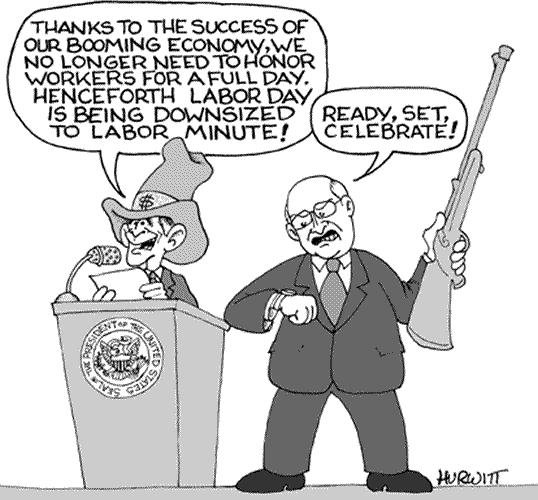
Why? In 2017, the topic of many conversations among reasonable people often includes wanting to know why.
Why Trump, why mass shootings, why massive student debt, why deny
science, why any of this nonsense? And why does Republican Party policy
enable and encourage the worst of humanity's traits and facilitate
today’s catastrophes? While there are no Oracles nor prophets to consult, we must discern for ourselves the shape of the society we inhabit.
Here are a few observations I've made.
Political analysts, you may recall, described Sarah Palin support as a
deviation from the Republican Party’s attitudes rather than an accurate
reflection of them. Traditional conservatives they claimed, valued small
government, a balanced budget, and restrained conduct in public. Yet Palin was impulsive, incoherent, and completely reactionary.
I disagree with that, I would say that Palin was no aberration at all.
But a typical bellowing bloviator within the history of conservative
beliefs. Palin, brought to the national spotlight opened the door for a
Trump presidency though. Conservative thought through history
principally reacts against egalitarian demands; it is committed entirely
to conserving a social order marked out by hierarchy. History shows
that for instance, conservatives opposed the labor movement, the women's
rights movement, the civil rights movement, and rights for LGBT
citizens. Why? because each has threatened existing hierarchy—and
conservatives’ grasp on the power to control society.
Palin and
Trump's appeal demands some sort of unifying theory. How can it be that
the party of Senator Ben Sasse—who enjoys a (mostly-unearned) reputation
as a moderate—is also the party of Trump? The answer is less difficult
to discern than it was back in 2011.
We reasonable people seem befuddled by Trump, unable to describe his actions as anything beyond “this is not normal.”
I suggest Trump makes sense as a truly quintessential conservative
figure (as did Palin). His peculiarities do not place him outside the
movement that propelled each of them to prominence. His populism is as
about as substantive as his business acumen; his rhetoric is empty as
intergalactic space. . He is an elitist, and he understands what it
means to thoroughly embrace "the free market". Despite being a chronic
liar, in many respects, he’s the most honest conservative in power, with
no pretensions of concern for anyone or anything but himself.
Consider Burke’s conviction that the market, and the “monied men” who
control it, should determine value. Burke scorned both the Levellers and
the French Revolution, mostly for the same reason: They wanted to
overthrow an order that he wanted to preserve. His theories of value
were central to defining and defending that order. Burke argued both
that value is “subjective,” and that there is an objective “hierarchy of
value that divides and distinguishes rich from poor, capital from
labor.”
Similarly, Nietzsche later feared that the demands of
workers presented serious threats to his sense of order, writing that
they would tear “down the walls of culture.” In this aspect, he
articulates the ideals of the Austrian school in economics and
contemporary conservatives, who frequently speak of the dignity of work
and the glories of free enterprise as if both comprise an intrinsic
cultural facet of American national identity. You hear them praise
“liberty,” and laud America’s role in defending it. But what do they
mean?
Conservatives may praise the worker when it is time to win
Wisconsin’s electoral votes, but when they are in power we see who they
really admire, and that is the CEO. If workers were able to determine
their own value, they would not choose to occupy a low position. They
would not choose to be subjugated nor have their wages compete in a race
to the bottom.
At the core of the conservative tradition is the
defense of the stratification of society into upper and lower classes.
Conservatives do not all justify this stratification in the same way, or
communicate it in the same terms. Some, like Palin, or the so called
Christian Right conceive of it as a religious order. Others, like Paul
Ryan prefer the purity of Ayn Randian narcissism. But they share a
belief in hierarchy, the rights of a few to dominate the many... and an
opposition to equality & egalitarianism.
This right to be a
vested interest, this opposition to altruism, this vindictive
justification of greed ironically is what they are calling liberty, and a
few probably believe that they are telling the truth. Beneath this,
"populism" is a marketing gimmick. It’s meant to lull you, to sell you
something that in reality you don't need nor want.
And so we have
Trump, the salesman-in-chief, a carnival barker, and a con man. He has
“revised” the conservative script, but his most virulent qualities do
not subvert it at all. In his book, "The Reactionary Mind"; Political Science professor Corey Robin says:
“The racism of the Trumpist right is nastier than its most recent
predecessors, but the weaponization of racism and nativism under Trump
is an intensification of a well-established tradition on the right, as
studies of American conservatism from the 1920s through the Tea Party
have shown.”
Strom Thurmond and Lee Atwater might be dead, but
their party certainly hasn’t turned away from white supremacy. The war
on drugs, hardline immigration policies, the privatization of public
schools, the weakening of organized labor...Republican policies continue
to disproportionately target people of color and reinforce the
injustices previously bestowed on them by slavery, Jim Crow, and
violent, organized groups. Trump’s racism is only a more open expression of older beliefs. As is the oafish manner in which he politicizes his own wealth.
Trump is not versed in the history of conservative ideas. His ascent
shows that one need not be conversant with the conservative tradition in
order to take an important place in it. His grotesque celebration of
greed and wealth are not out of step with conservative norms. Perhaps a bit more banal and gaudy...but greed has always been the guiding force behind conservatism.
As we witness some of the right's spokesmen & rhetors complaining
about Trump, we observe it is because he puts forward competing visions
of the market. In Trump's book "The Art of the Deal", he mounts a
persistent question of the value of capitalism insisting “A lot of
attention alone creates value.” Trump celebrates the market, and the
position he has created for himself within it. It is a world, and he is
its strongman Fuhrer. This is a telling admission in the book...
“The market is a moment of truth — and an eternity of lies. It reveals;
it hides. It is everything; it is nothing. It shall be all; it is
naught.” Trump believes in the market. He believes in himself as an economic “warrior prince.”
He grasps the utter futility of it all. According to Trump, there is no
truth. "It’s a show about nothing.” Trump takes literally the
conservative slogan that government should be run like a business...his
business.
Trump’s literalism may serve as a useful indicator of
the conservative movement’s general health. For Republicans. Trump’s
agenda, which is a Republican agenda, has stalled. His popularity is
plummeting; recent polls suggest that most American voters currently
want the Democratic party to recapture Congress. Trump hasn’t been able
to channel resentment into governance, and his failures leave the
conservative movement vulnerable.
So what do we need to do? How
do we counter religious fervor, and the mythology of the market’s
liberatory potential? How do we counter Trump’s grotesque materialism
without a competing, egalitarian economic vision?
If equality
and fairness is to have a turn in the seat of power, We must take on the
economic forces that keep it out of reach! While Democrats have
done a reasonable job of taking on racism, sexism, and homophobia. What
is needed now is a competing economic plan that benefits all, instead of
the few already doing well. Yes, seems like a no brainer...but where is
this plan? It needs to be developed and must be capable of being
explained in a sentence or two. (This is where we fail to connect
with "average voters" by and large...we have had good policies but have
been unsuccessful in selling them largely because nuanced policy isn't
easy to package into a short marketing slogan. I am not the guy for this
obviously...I salute you for your attention span if you've read this
far!
But folks like you and I, who maintain interest this long,
are not the norm anymore. The left fails to understand the huge role
marketing techniques play. We debunk some nonsense once and move on
thinking the issue was resolved while conservative rhetors simply keep
pounding away with their debunked assertion. And the technique sadly works.
Economic Fairness.
In this effort, we will find no allies in the conservative movement.
Moderate conservatives may be useful as a vote against the worst of
Trump’s legislative agenda. But thinking if we moderate our agenda to
court them is a pathological view. It will condemn any and all resistance efforts to failure.
Conservatives will never work for you, not unless you are already truly
filthy rich, pious in designated fashions, unduly Caucasian, old...(but
not old enough for social security, which you don't care about, because
it's chump change for you), and excessively male.
The problem
is not particularly egregious conservative politicians like Trump or
Palin, but conservative politics itself. Ours must be better. We can
only respond to a show about nothing with something; with substance, and
with political force. This my friends is the reality.
Mythology...the collection of parable, analogy, and metaphors from the history of man's psyche.
Most myths have some underlying truth to convey to an astute reader.
Like the tale of the Trojan Horse for instance.
On closer inspection things may not be as they seem.
I myself, though essentially an ardent fan of reason,
would not care to live in a world devoid of myths.
Though it is quite dangerous to cross the Rubicon into that realm where one believes
mythologies are factual and literally true.
We have in recent times witnessed the birth of a new mythology my friends and most honored readers....
yes
It is not however, a mythology created from bards and writers.
Nor is it wisdom handed down in stories through generations.
It is created by modern public relations think tanks
in service of those who at all times and in all places
throughout history have banded together to set themselves up as
an aristocracy of some sort.
This is nothing new.
From the pharaohs of ancient Egypt to the self-regarding thugs of
ancient Rome to the glorified warlords of medieval Europe, in nearly every urbanized society throughout human history,
there have been people who have tried to constitute themselves as
an aristocracy.
These people and their allies are the conservatives.
Conservatism at all times in all places is always an argument
for absolutism...for an aristocracy of some sort
to dominate society.
Today, they use (quite successfully) the machines of Public Relations
to create a mythology that essentially is a Trojan Horse.
Once the "gift" is accepted,
all is lost.
"Just what is this modern mythology?" you ask.
There are many changing and developing facets to it...
like the Zygote in the film "Alien" it morphs after it has used it's host.
Changes from one host to another absorbing bits of the hosts DNA in it's new form.
The host, once invaded though does not survive.
Let's look at some examples.
These concepts and statistics deal largely with the U.S.A.
but overall the entire world is dealing with these issues
in various incarnations of "austerity" programs and such.
Mythologies Created About Health Care
Private Insurance costs far more money than Medicare does.
According to the Council for Affordable Health Insurance ,
medical administrative costs as a percentage of claims
are about three
times higher for private insurance than for Medicare.
The U.S. Institute of Medicine reports
that the for-profit system
wastes $750 billion a year on waste, fraud,
and inefficiency.
As a percent of GDP, we spend $1.2 trillion more than
the OECD average here in the U.S.
So all of you teabaggers out there screaming about socialism,
and shouting down the handicapped at town halls, this amount is equal to the entire U.S. deficit.
That's right, the amount wasted on achieving profits for private medical care companies, if instead was applied to the deficit would eliminate it. One out of every six dollars you earn goes to health care.
The mythology of private health insurance being better than a not for profit system is but one example of this Trojan Horse.
Privatizing Social Security Is Good
No, It's not.
Another myth cooked up by the slogan generators.
Administrative costs for 401(k) plans are much higher than those for Social Security -- up to twenty times more.
It would be difficult to find, or even imagine, any short-term-profit-based private insurer that is fully funded for the next 25 years . Social Security is. It works for all retirees while private plans work for a limited number of investors.
Essentially this myth is created by the Wall Street Casino
that would like you to bet your retirement at their tables.
An occasional winner, but the house always wins...and the vast majority loose.
Social Security is a not for profit insurance that you purchased.
It is not "an entitlement".
It was never meant to be part of the general fund.
It is not gambling.
(the way private retirement funds are)
The only risk in social security is that politicians will destroy the program
so they won't have to return what they have stolen from it.
Public Funding Is Bad, Private Banks Are Good
Balderdash. No way.
Cities
and towns around the country have been repeatedly victimized
by a "bid-rigging" process
that diverts billions of dollars
from
numerous unsuspecting communities to the accounts of a few big banks.
Individual homeowners, especially minorities, have also been
victimized by the banks.
Because of the housing crash and the
corresponding decrease in home values, middle class households lost over half
of their median wealth , and minority households almost two-thirds.
There are simply a plethora of scandals and scams in banking.
The privately run Mortgage Electronic Registration System (MERS) headed up the illegal foreclosure business; the banking association LIBOR was guilty of interest rate manipulation;
and numerous financial institutions have engaged in the subtle artistry of imposing hidden fees .
Your credit cards are loaded with "gray charges"
things like surprise subscriptions and auto-renewals
little scams that cost the average consumer $356 a year.
Unbelievably it has been estimated that 40% of every dollar
we spend on goods and services goes to banks as interest.
40%
Really.
Public banks ,
on the other hand, focus on the needs of communities and small
businesses rather than on investors. The most well-known example is the
Bank of North Dakota (BND),
which has successfully worked with local banks throughout the state,
promoting business growth through loans that a larger bank might be
reluctant to make, while managing to turn a profit every year for the
past 40 years.
This is the system that wants no government oversight..."trust us".
This is the system that caused the collapse of the worlds economies
through it's own irresponsible risk taking
and manages now, to have you and I dear reader,
cover their losses.
Government at this time is not your enemy, nor is it big enough
to effectively battle
multinational banking cartels.
What vestiges remain of democracy
dwindle further each day
As more people buy into the manufactured myths of the would-be Pharaohs.
The legend of the Big Box
Smaller government is promoted by the very companies that make record
profits
while forcing their employees to accept public assistance.
While McDonald's enjoyed profits of 130 percent over the past four years, and Pizza Hut, Taco Bell and KFC made 45 percent, and while the Walton family (owners of Walmart) made $20 billion in one year ,
the median hourly wage for food service workers and Walmart employees
is about $9 an hour. Many workers are stuck at the $7.25 minimum wage,
which according to the National Employment Law Project is worth 30 percent less than it was in 1968.
Food service and big box store employees, are the fastest-growing job
segments in the nation, and these people are making barely enough to stay out of
poverty.
It is not just the employees who subsidize their
bosses.
We all are.
Every one of us.
Low-wage employees are dependent on the food stamps and Medicaid
which of course are paid for by our tax dollars.
The idea that somehow
cheap shoddy goods
benefit you
is a myth.
Government Is Bad
Libertarianism is corporatism in a sheep's clothing.
Ok all you big government haters out there...ask yourself these questions if you will...
What is the incentive for private companies to deal with tragedies like Hurricane Sandy?
The Pacific Standard aptly stated that "the free market doesn't want to be in the flood business."
Face it there is no profit in it.
Private industry is fine for some things.
Not all things.
What is the incentive for private companies to keep poisons out drinking water?
If it is more profitable to dump toxins indiscriminately into the environment
than to behave civilly.
Private industry time and again has demonstrated
it has little interest in civility.
Short term profits trump long term survival.
Time and again.
Without sufficient government regulations
the
Clean Water Act was violated a half-million times in one year.
In one year.
(worth repeating).
What might the incentive for private companies to plow your roads?
Could a corporate entity do it cheaper considering they need to make skyrocketing profits year after year?
Considering they have a culture whereby they insist the top executives
must be paid scores of millions of dollars
annually and drown in perks and bonuses
or their talents will go elsewhere
where others have been duped into believing
a manger is to be paid hundreds of thousands of times more
than the mere workers.
No.
Must a profit be made by someone on every human endeavor?
Really?
Liars and paper tigers and bear markets oh my!
What incentive might industry have to reduce the number of prisoners in profit-seeking prisons?
Or to allow you to send a birthday card for just 45 cents?
Or to simply treat its customers with a degree of respect rather than as a source of profit?
A battery to drain power from
and toss in the rubbish.
The "invisible hand" of the free market is often picking our pockets.
In many ways it is both unable and unwilling to
satisfy the needs of society.
It has a place...but perhaps not at the top of pyramid.
The free market is not free.
There is a cost.
Paid for in both currency...and loss of humanity
For that it is worthy
of our contempt.
Not our awe.
Liars and paper tigers and bear markets oh my!
This is some horseshit of a different color!
Keynes got it right.
Balance is the trick.
Humanity trumps profits.
Bertrand Russel said "There are still many people in America who regard depressions as acts of God. I think Keynes proved that the responsibility for these occurrences does not rest with Providence.... Keynes's intellect was the sharpest and clearest that I have ever known. When I argued with him, I felt that I took my life in my hands, and I seldom emerged without feeling something of a fool. I was sometimes inclined to feel that so much cleverness must be incompatible with depth, but I do not think that this feeling was justified."
Mention the name of John Maynard Keynes to a conservative, and something close to an epileptic fit will ensue. Yet in reality, I suggest it was Keynes and his out of the box thinking, along with that other fellow whose name elicits rabid foam from the mouths of conservatives; Franklin Delano Roosevelt (who implemented many of Keynes economic ideas), that saved capitalism by taming it, regulating it, and molding it. (Had they not done this, communism or fascism would have likely been implemented to escape the Great Depression. Many of America's wealthy believed in Fascism and supported Hitler both in ideology and in financial arrangements). And frankly, if Keynesian economics and the Roosevelt controls on capitalism hadn't been overthrown in favor of a return to deregulated "Lazy Fairy" markets, (which caused the great depression), today's economic collapse could not have occurred. Keynes was essentially about full employment and the belief that capital was a means to an end...not and end in itself. Deficit spending as investment in the future. Not to give wealthy tax cuts. Not to wage wars of choice for corporate imperialism. We can rest assured that his view of deficit spending for these purposes during times of relative prosperity would be a dim one. I for one, raise a glass in honor of his wisdom, courage, and indeed his wit which is in evidence in this small collection of my favorite quotes of his. Speaking of which, here they are!
One reason FDR was able to pass his ambitious agenda was he had massive support in the Legislature.
“Capitalism is the astounding belief that the most wickedest of men will do the most wickedest of things for the greatest good of everyone.”
“It is better to be vaguely right than precisely wrong”
"The disruptive powers of excessive national fecundity may have played a greater part in bursting the bonds of convention than either the power of ideas or the errors of autocracy."
“The difficulty lies not so much in developing new ideas as in escaping from old ones.”
"Newton was not the first of the age of reason. He was the last of the magicians, the last of the Babylonians and Sumerians, the last great mind that looked out on the visible and intellectual world with the same eyes as those who began to build our intellectual inheritance rather less than 10 000 years ago. "
"They offer me neither food nor drink — intellectual nor spiritual consolation... Conservatism leads nowhere; it satisfies no ideal; it conforms to no intellectual standard, it is not safe, or calculated to preserve from the spoilers that degree of civilisation which we have already attained. "
“The love of money as a possession - as distinguished from the love of money as a means to the enjoyments and realities of life - will be recognized for what it is, a somewhat disgusting morbidity, one of those semi-criminal, semi-pathological propens”
"Perhaps a day might come when there would be at last be enough to go round, and when posterity could enter into the enjoyment of our labors."
FDR Fireside Chats
"This is a nightmare, which will pass away with the morning. For the resources of nature and men's devices are just as fertile and productive as they were. The rate of our progress towards solving the material problems of life is not less rapid. We are as capable as before of affording for everyone a high standard of life...and will soon learn to afford a standard higher still. We were not previously deceived. But to-day we have involved ourselves in a colossal muddle, having blundered in the control of a delicate machine, the working of which we do not understand. The result is that our possibilities of wealth may run to waste for a time—perhaps for a long time." -(1930), Essays in Persuasion
"The decadent international but individualistic capitalism in the hands of which we found ourselves after the war is not a success. It is not intelligent. It is not beautiful. It is not just. It is not virtuous. And it doesn't deliver the goods. "
The Keynesian Cross
“Lenin is said to have declared that the best way to destroy the capitalist system was to debauch the currency. By a continuing process of inflation, governments can confiscate, secretly and unobserved, an important part of the wealth of their citizens. By this method they not only confiscate, but they confiscate arbitrarily; and, while the process impoverishes many, it actually enriches some. The sight of this arbitrary rearrangement of riches strikes not only at security, but at confidence in the equity of the existing distribution of wealth. Those to whom the system brings windfalls, beyond their deserts and even beyond their expectations or desires, become 'profiteers,' who are the object of the hatred of the bourgeoisie, whom the inflationism has impoverished, not less than of the proletariat. As the inflation proceeds and the real value of the currency fluctuates wildly from month to month, all permanent relations between debtors and creditors, which form the ultimate foundation of capitalism, become so utterly disordered as to be almost meaningless; and the process of wealth-getting degenerates into a gamble and a lottery. Lenin was certainly right. There is no subtler, no surer means of overturning the existing basis of society than to debauch the currency. The process engages all the hidden forces of economic law on the side of destruction, and does it in a manner which not one man in a million is able to diagnose..” - The Economic Consequences of Peace
“The power of vested interests is vastly exaggerated compared with the gradual encroachment of ideas”
"The classical theorists resemble Euclidean geometers in a non-Euclidean world who, discovering that in experience straight lines apparently parallel often meet, rebuke the lines for not keeping straight—as the only remedy for the unfortunate collisions which are occurring. Yet, in truth, there is no remedy except to throw over the axiom of parallels and to work out a non-Euclidean geometry. "
"The day is not far off when the economic problem will take the back seat where it belongs, and the arena of the heart and the head will be occupied or reoccupied, by our real problems - the problems of life and of human relations, of creation and behavior and religion."
“The social object of skilled investment should be to defeat the dark forces of time and ignorance which envelope our future.”
“Regarded as a means, (the businessman) is tolerable; as an end, he is not so satisfactory”
“Most men love money and security more, and creation and construction less, as they get older”
"When the facts change, I change my mind. What do you do, sir?" -Reply to a criticism during the Great Depression of having changed his position on monetary policy
“For at least another hundred years we must pretend to ourselves and to every one that fair is foul and foul is fair; for foul is useful and fair is not. Avarice and usury and precaution must be our gods for a little longer still.”
“The engine which drives enterprise is not thrift, but profit”
"We reach a condition where there is a shortage of houses, but where nevertheless no one can afford to live in the houses that there are."
"When the accumulation of wealth is no longer of high social importance, there will be great changes in the code of morals. We shall be able to rid ourselves of many of the pseudo-moral principles which have hag-ridden us for two hundred years, by which we have exalted some of the most distasteful of human qualities into the position of the highest virtues".
“The importance of money flows from it being a link between the present and the future.”
“It would not be foolish to contemplate the possibility of a far greater progress still.”
“Words ought to be a little wild, for they are the assaults of thoughts on the unthinking.”
“Americans are apt to be unduly interested in discovering what average opinion believes average opinion to be...”
"For my part I think that capitalism, wisely managed, can probably be made more efficient for attaining economic ends than any alternative system yet in sight, but that in itself it is in many ways extremely objectionable."
"If I am right in supposing it to be comparatively easy to make capital-goods so abundant that the marginal efficiency of capital is zero, this may be the most sensible way of gradually getting rid of many of the objectionable features of capitalism."
"The outstanding faults of the economic society in which we live are its failure to provide for full employment and its arbitrary and inequitable distribution of wealth and incomes."
"In the long run, we're all dead."
John Maynard Keynes (1883 – 1946)
"I should have drunk more champagne." These were his last words. (according to Ben Trovato's Art of Survival (2007) by Ben Trovato, p. 196)
"We had to struggle with the old enemies of peace—business and financial monopoly, speculation, reckless banking, class antagonism, sectionalism, war profiteering. They had begun to consider the Government of the United States as a mere appendage to their own affairs. We know now that Government by organized money is just as dangerous as Government by organized mob." -FDR
The corruption of justice perpetrated by the Supreme Court, the very people sworn to protect the constitution of the U.S.; ushers in a new era of absolute corporate totalitarianism. Untethered and unrestrained from any reasonable safety constraints, free speech is drowned out by money. Those who spend the most will be amplified. Those, regardless of their numbers, who can not drop millions on campaigns will be silenced. The intent of the constitution, obvious even to an 11 year old, was not to give "monied corporations and banking institutions" (as Jefferson referred to them...saying they were more dangerous than standing armies to democracy) the ability to freely purchase government itself. "Sure, Mr. Jones, Exxon would like to help you become a Senator, but we need those restrictions about drilling under the Washington Monument lifted, and we sure would like a crack at those Iranian oil reserves..."
History Repeats Itself
Like Bill Murray in the movie "Groundhog Day", time and time again the same loop is run again and again. The forces of sociopathic greed convince leaders greed is good; that restraining it in any way is harmful. Because history dims, or perhaps is simply ignored, anti-trust acts are repealed and monopolies flourish. Speculators inflate market prices until they burst. It's nothing new. The events leading to our current economic woes are identical to the events that lead to the great depression. The solution is remarkably simple in theory.
"People want peace that comes from security in their homes: safety for their savings, permanence in their jobs, a fair profit from their enterprise." -FDR
Any policy that encourages the realization of these desires is a good policy, any policy that erodes them is bad policy. Let's have a look at what Franklin Delano Roosevelt said about this in his speech at Madison Square Gardens on October 31, 1936-
Transcript - Senator Wagner, Governor Lehman, ladies and gentlemen:
On the eve of a national election, it is well for us to stop for a moment and analyze calmly and without prejudice the effect on our Nation of a victory by either of the major political parties.
The problem of the electorate is far deeper, far more vital than the continuance in the Presidency of any individual. For the greater issue goes beyond units of humanity—it goes to humanity itself.
In 1932 the issue was the restoration of American democracy; and the American people were in a mood to win. They did win. In 1936 the issue is the preservation of their victory. Again they are in a mood to win. Again they will win.
More than four years ago in accepting the Democratic nomination in Chicago, I said: "Give me your help not to win votes alone, but to win in this crusade to restore America to its own people."
The banners of that crusade still fly in the van of a Nation that is on the march.
It is needless to repeat the details of the program which this Administration has been hammering out on the anvils of experience. No amount of misrepresentation or statistical contortion can conceal or blur or smear that record. Neither the attacks of unscrupulous enemies nor the exaggerations of over-zealous friends will serve to mislead the American people.
What was our hope in 1932? Above all other things the American people wanted peace. They wanted peace of mind instead of gnawing fear.
First, they sought escape from the personal terror which had stalked them for three years. They wanted the peace that comes from security in their homes: safety for their savings, permanence in their jobs, a fair profit from their enterprise.
Next, they wanted peace in the community, the peace that springs from the ability to meet the needs of community life: schools, playgrounds, parks, sanitation, highways—those things which are expected of solvent local government. They sought escape from disintegration and bankruptcy in local and state affairs.
They also sought peace within the Nation: protection of their currency, fairer wages, the ending of long hours of toil, the abolition of child labor, the elimination of wild-cat speculation, the safety of their children from kidnappers.
And, finally, they sought peace with other Nations—peace in a world of unrest. The Nation knows that I hate war, and I know that the Nation hates war.
I submit to you a record of peace; and on that record a well-founded expectation for future peace—peace for the individual, peace for the community, peace for the Nation, and peace with the world.
Tonight I call the roll—the roll of honor of those who stood with us in 1932 and still stand with us today.
Written on it are the names of millions who never had a chance—men at starvation wages, women in sweatshops, children at looms.
Written on it are the names of those who despaired, young men and young women for whom opportunity had become a will-o'-the-wisp.
Written on it are the names of farmers whose acres yielded only bitterness, business men whose books were portents of disaster, home owners who were faced with eviction, frugal citizens whose savings were insecure.
Written there in large letters are the names of countless other Americans of all parties and all faiths, Americans who had eyes to see and hearts to understand, whose consciences were burdened because too many of their fellows were burdened, who looked on these things four years ago and said, "This can be changed. We will change it."
We still lead that army in 1936. They stood with us then because in 1932 they believed. They stand with us today because in 1936 they know. And with them stand millions of new recruits who have come to know.
Their hopes have become our record.
We have not come this far without a struggle and I assure you we cannot go further without a struggle.
For twelve years this Nation was afflicted with hear-nothing, see-nothing, do-nothing Government. The Nation looked to Government but the Government looked away. Nine mocking years with the golden calf and three long years of the scourge! Nine crazy years at the ticker and three long years in the breadlines! Nine mad years of mirage and three long years of despair! Powerful influences strive today to restore that kind of government with its doctrine that that Government is best which is most indifferent.
For nearly four years you have had an Administration which instead of twirling its thumbs has rolled up its sleeves. We will keep our sleeves rolled up.
We had to struggle with the old enemies of peace—business and financial monopoly, speculation, reckless banking, class antagonism, sectionalism, war profiteering.
They had begun to consider the Government of the United States as a mere appendage to their own affairs. We know now that Government by organized money is just as dangerous as Government by organized mob.
Never before in all our history have these forces been so united against one candidate as they stand today. They are unanimous in their hate for me—and I welcome their hatred.
I should like to have it said of my first Administration that in it the forces of selfishness and of lust for power met their match. I should like to have it said of my second Administration that in it these forces met their master.
The American people know from a four-year record that today there is only one entrance to the White House—by the front door. Since March 4, 1933, there has been only one pass-key to the White House. I have carried that key in my pocket. It is there tonight. So long as I am President, it will remain in my pocket.
Those who used to have pass-keys are not happy. Some of them are desperate. Only desperate men with their backs to the wall would descend so far below the level of decent citizenship as to foster the current pay-envelope campaign against America's working people. Only reckless men, heedless of consequences, would risk the disruption of the hope for a new peace between worker and employer by returning to the tactics of the labor spy.
Here is an amazing paradox! The very employers and politicians and publishers who talk most loudly of class antagonism and the destruction of the American system now undermine that system by this attempt to coerce the votes of the wage earners of this country. It is the 1936 version of the old threat to close down the factory or the office if a particular candidate does not win. It is an old strategy of tyrants to delude their victims into fighting their battles for them.
Every message in a pay envelope, even if it is the truth, is a command to vote according to the will of the employer. But this propaganda is worse—it is deceit.
They tell the worker his wage will be reduced by a contribution to some vague form of old-age insurance. They carefully conceal from him the fact that for every dollar of premium he pays for that insurance, the employer pays another dollar. That omission is deceit.
They carefully conceal from him the fact that under the federal law, he receives another insurance policy to help him if he loses his job, and that the premium of that policy is paid 100 percent by the employer and not one cent by the worker. They do not tell him that the insurance policy that is bought for him is far more favorable to him than any policy that any private insurance company could afford to issue. That omission is deceit.
They imply to him that he pays all the cost of both forms of insurance. They carefully conceal from him the fact that for every dollar put up by him his employer puts up three dollars three for one. And that omission is deceit.
But they are guilty of more than deceit. When they imply that the reserves thus created against both these policies will be stolen by some future Congress, diverted to some wholly foreign purpose, they attack the integrity and honor of American Government itself. Those who suggest that, are already aliens to the spirit of American democracy. Let them emigrate and try their lot under some foreign flag in which they have more confidence.
The fraudulent nature of this attempt is well shown by the record of votes on the passage of the Social Security Act. In addition to an overwhelming majority of Democrats in both Houses, seventy-seven Republican Representatives voted for it and only eighteen against it and fifteen Republican Senators voted for it and only five against it. Where does this last-minute drive of the Republican leadership leave these Republican Representatives and Senators who helped enact this law?
I am sure the vast majority of law-abiding businessmen who are not parties to this propaganda fully appreciate the extent of the threat to honest business contained in this coercion.
I have expressed indignation at this form of campaigning and I am confident that the overwhelming majority of employers, workers and the general public share that indignation and will show it at the polls on Tuesday next.
Aside from this phase of it, I prefer to remember this campaign not as bitter but only as hard-fought. There should be no bitterness or hate where the sole thought is the welfare of the United States of America. No man can occupy the office of President without realizing that he is President of all the people.
It is because I have sought to think in terms of the whole Nation that I am confident that today, just as four years ago, the people want more than promises.
Our vision for the future contains more than promises.
This is our answer to those who, silent about their own plans, ask us to state our objectives.
Of course we will continue to seek to improve working conditions for the workers of America—to reduce hours over-long, to increase wages that spell starvation, to end the labor of children, to wipe out sweatshops. Of course we will continue every effort to end monopoly in business, to support collective bargaining, to stop unfair competition, to abolish dishonorable trade practices. For all these we have only just begun to fight.
Of course we will continue to work for cheaper electricity in the homes and on the farms of America, for better and cheaper transportation, for low interest rates, for sounder home financing, for better banking, for the regulation of security issues, for reciprocal trade among nations, for the wiping out of slums. For all these we have only just begun to fight.
Of course we will continue our efforts in behalf of the farmers of America. With their continued cooperation we will do all in our power to end the piling up of huge surpluses which spelled ruinous prices for their crops. We will persist in successful action for better land use, for reforestation, for the conservation of water all the way from its source to the sea, for drought and flood control, for better marketing facilities for farm commodities, for a definite reduction of farm tenancy, for encouragement of farmer cooperatives, for crop insurance and a stable food supply. For all these we have only just begun to fight.
Of course we will provide useful work for the needy unemployed; we prefer useful work to the pauperism of a dole.
Here and now I want to make myself clear about those who disparage their fellow citizens on the relief rolls. They say that those on relief are not merely jobless—that they are worthless. Their solution for the relief problem is to end relief—to purge the rolls by starvation. To use the language of the stock broker, our needy unemployed would be cared for when, as, and if some fairy godmother should happen on the scene.
You and I will continue to refuse to accept that estimate of our unemployed fellow Americans. Your Government is still on the same side of the street with the Good Samaritan and not with those who pass by on the other side.
Again—what of our objectives?
Of course we will continue our efforts for young men and women so that they may obtain an education and an opportunity to put it to use. Of course we will continue our help for the crippled, for the blind, for the mothers, our insurance for the unemployed, our security for the aged. Of course we will continue to protect the consumer against unnecessary price spreads, against the costs that are added by monopoly and speculation. We will continue our successful efforts to increase his purchasing power and to keep it constant.
For these things, too, and for a multitude of others like them, we have only just begun to fight.
All this—all these objectives—spell peace at home. All our actions, all our ideals, spell also peace with other nations.
Today there is war and rumor of war. We want none of it. But while we guard our shores against threats of war, we will continue to remove the causes of unrest and antagonism at home which might make our people easier victims to those for whom foreign war is profitable. You know well that those who stand to profit by war are not on our side in this campaign.
"Peace on earth, good will toward men"—democracy must cling to that message. For it is my deep conviction that democracy cannot live without that true religion which gives a nation a sense of justice and of moral purpose. Above our political forums, above our market places stand the altars of our faith—altars on which burn the fires of devotion that maintain all that is best in us and all that is best in our Nation.
We have need of that devotion today. It is that which makes it possible for government to persuade those who are mentally prepared to fight each other to go on instead, to work for and to sacrifice for each other. That is why we need to say with the Prophet: "What doth the Lord require of thee—but to do justly, to love mercy and to walk humbly with thy God." That is why the recovery we seek, the recovery we are winning, is more than economic. In it are included justice and love and humility, not for ourselves as individuals alone, but for our Nation.
That is the road to peace.
It should be noted that the man historians regard as the greatest modern president (he was elected 4 times as president, & I imagine had he not passed on in office, he would have been elected yet again and again) was certainly one of the strongest American presidencies, yet he personally suffered from debilitating polio. He attempted to downplay his handicap in public, keeping his agony private. He suffered not only immobility but searing pain from the affliction. For those who are interested in the Roosevelt presidency, the FDR monument in Washington D.C. is quite an experience. The monument is spread out, offering several statues, trees, waterfalls, and seclusion. This monument is one of the newest,it was built only in 1997.In the stone work are many quotes to ponder and the memorial offers four outdoor galleries. The first depicts FDR’s first term, when he launched the New Deal programs. The second and third rooms remember his term, which included WW II. The last room offers a reflection of the life of FDR. There is a huge statue of Roosevelt sitting with his dog.
I recommend seeing the monument lit up in the moonlight. The bronze statues greet you as you enter the outdoor monument. One depicts him in his wheelchair; another statue is him talking in a radio for his "fireside chats." Large, oversize building blocks and water with multicolor lights make this an enchanting spectacle. It includes a maze of fountains with stepping stones to stand on behind a waterfall. You can later walk to the Tidal Basin and see Jefferson's Monument at night and cherry blossoms (In Spring, just around the corner...) drenched in shadows. A breathtaking experience.
“There’s class warfare, all right, but it’s my class, the rich class, that’s making war, and we’re winning.” - Warren Buffet
Few would argue that Warren Buffet is a very smart fellow. And his statement is not as condescending as it sounds...he was commenting on the fact that his employees pay around a third of their net income in taxes while he, one of the wealthiest men in America; pays less than 13%. He said he uses no tax planning and makes no efforts to weasel out of paying such as hiding money in tax shelters etc. but this unfair tax situation is simply evidence of class warfare...the war of the outrageously wealthy against everyone else. And They are indeed winning, if they have not already won.
Welcome To The Dog And Pony Show An American businessman who recently moved his manufacturing operations to Mexico was standing at the pier of a small coastal village when a small boat with just one fisherman docked. Inside the small boat were several large yellowfin tuna. The Globalist complimented the Mexican on the quality of his fish.
“How long it took you to catch them?” The globalist asked.
“Only a little while.” The Mexican replied.
“Why don’t you stay out longer and catch more fish?” The globalist then asked.
“I have enough to support my family’s immediate needs.” The Mexican said.
“But,” The American globalist then asked, “What do you do with the rest of your time?”
The Mexican fisherman said, “I sleep late, fish a little, play with my children, take a siesta with my wife, Maria, stroll into the village each evening where I sip wine and play guitar with my amigos, I have a full and busy life, señor.”
The American capitalist scoffed, “I am a Harvard MBA and I could help you. You should spend more time fishing and with the proceeds you buy a bigger boat, and with the proceeds from the bigger boat you could buy several boats, eventually you would have a fleet of fishing boats.”
“Instead of selling your catch to a middleman you would sell directly to the consumers, eventually opening your own can factory. You would control the product, processing and distribution. You would need to leave this small coastal fishing village and move to Mexico City, then LA and eventually NYC where you will run your expanding enterprise.”
The Mexican fisherman asked, “But señor, how long will this all take?”
To which the American replied, “15-20 years.”
“But what then, señor?”
The American laughed and said, “That’s the best part. When the time is right you would announce an IPO and sell your company stock to the public and become very rich, you would make millions.”
“Millions, señor? Then what?”
The American said slowly, “Then you would retire. Move to a small coastal fishing village where you would sleep late, fish a little, play with your grandkids, take a siesta with your wife, stroll to the village in the evenings where you could sip wine and play your guitar with your amigos…”
Get the picture?
Most of us see success in life as having enough to be comfortable, have some degree of security, and experience life's joys. Some, and I suggest this is a sociopathic quality, can't get enough. They can't experience happiness. They want it all, yours mine and ours. These sociopaths already own most assets and coins on earth, but it's not enough. It will never ever be enough.
Now allow me to interject at this point that I'm not suggesting that all wealthy people are sociopaths, Warren Buffet for instance has every right in my view to make profit from his smarts, at least he has some grounding that makes him understand he too should be taxed for services at minimum, the same rate as his housekeeper. He, and people like him are not really the issue, (though I also understand the logic of the argument that anyone who has more than a fair share, ultimately takes it from someone else.) But that is not the focus of this article. This is about Global Class War waged, not by the poor, downtrodden, or trampled underfoot; but by sociopaths and their sycophants who can not rest until every drop of blood is wrung from every stone.
"We have to tolerate the inequality as a way to achieve greater prosperity and opportunity for all."
Huh? Really?
Those were the words of Lord Brian Griffiths, a former adviser to British Prime Minister Margaret Thatcher. And why the hell wouldn't Griffiths feel that way? After all, he's vice chairman of Goldman Sachs International. He personally experienced much, much "greater prosperity"thanks to record bonuses the banking giant paid out at the end of this year. So the "recession" is over, it's over for the world's obscenely wealthy. And no one else matters.
Goldman--along with plenty of other financial institutions--is in the midst of a bonus orgy, with end-of-year payouts to financial executives worth billions of dollars--allegedly for a job well done in 2009. Of course Goldman is one of the firms bailed out, allegedly saved from it's own extinction from U.S. taxpayers. Goldman isn't alone. Overall, Wall Street firms have paid out $140 billion in bonuses this year, according to a Wall Street Journal survey of 23 banks, investment firms, hedge funds and other institutions. That's $10 billion more than in 2007, the year before the financial meltdown and the high point of Wall Street's balloon. How on earth is this justifiable? It just isn't, and it doesn't matter, you'll subsidize this and like it! That's right you peasants, take it like a chump. Don't put up a fight, don't even whimper.
How did Wall Street recover so quickly that the banks could be wiping their asses with money again? To hear the banks tell it, their boffo quarterly earnings reports and the coming tidal wave of bonuses are the result of their financial skill--proof that the Wall Street Wizards are a cut above the rest of us. Certainly it's only fair that they should be showered with cash while the rest of us get hosed with layoffs, wage cuts, foreclosures and bankruptcies.
But that picture is a vile and pernicious fraud. The Banking Pirate's profits are being subsidized heavily with your money. Remember, these firms were given this money to make loans so credit didn't freeze up. It was for creating new jobs, restructuring mortgages and "trickling down" to Main Street.
That didn't happen did it?
Trickle Down Economics
So what did Goldman and other firms do with this free money? No, they didn't lend it out. Instead, the last quarter shows that almost all of Goldman's revenue in those months--$10 billion out of $10.8 billion--was from trading. Goldman posted its $3 billion in profits based largely on gains from trades and fees from customers. Goldman, in other words, is a bookie, and a gambler and little else.
The bottom line: Goldman didn't create a single job or stop a single foreclosure.
Responding to public anger at the size of Goldman's bonuses, the firm's Chief Financial Officer, David Vinar scoffed, "I do think it's too big a focus. I would prefer people to be focused on the success of our business, how well we're doing, and how well our people are performing."
Con men like Vinar think you are too stupid to understand the swindle they're operating. But it's obvious. As Elizabeth Warren, the Harvard professor and chair of the Congressional Oversight Panel created to oversee the Wall Street bailout, commented:
"So let me understand this. They can take taxpayer money and go out and make investments--gambles. These are not loans. This is not from lending activity, which is what I thought the banks were in the business of doing. Instead, they can go out and make short-term profits in investing and be rich, and that's the healing of the financial system? I'm sorry, I don't think so."
As for the bonuses, Warren said:
"I not only don't think it's appropriate...I am wordless over this. Speechless. I do not understand how it is that financial institutions can think that they can take taxpayer money, and then turn around and act like it's business as usual...I don't understand how they can't see the world has changed in a fundamental way. It is not business as usual when you take taxpayer dollars. But all I can say right now is that they seem to be winning this argument."
The unmitigated audacity of Wall Street was so over the top as to make even the Economist magazine blush. "Worst of all, bonuses are being paid in part from subsidies: this is not a free market, but a perversion of it." The magazine further wrote that banks "enjoy laxer accounting, loose collateral rules at central banks, explicit debt guarantees and asset-purchasing schemes. And critically, they can borrow cheaply because they are deemed too big to fail. All of them--from comparatively healthy Goldman to the nationalized weaklings--are being subsidized by the rest of us."
Warren Buffet has said he paid 13% of his income in taxes, this is without efforts to shelter or weasel out of paying through lobbying, cooking books, or offshore tax dodges like we have seen so many do . His housekeeper has to give 33% of her income. And yet the call from conservatives is to cut the tax rate for the wealthy even further.
Mention to conservatives or Republicans that we should consider some mode of equity in the tax system, that maybe these "Wizards" should contribute to their own subsidization, that the wealthiest men, as Warren Buffet says, should at least pay their fair share... and free marketeers and conservatives will purvey several arguments. The first argument is that this mere suggestion constitutes class warfare. I think Mr. Buffett already answered that one. Resistance is futile. The mere concept of resistance is taboo.
The other argument is that raising taxes actually lowers tax revenues. "Huh"? That's right, total revenues will increase if they aren't paid, so only cutting taxes stimulates federal revenue. They claim this is proved by the history of tax receipts during the George W. Bush presidency. But, in fact, the federal government collected roughly $1.004 trillion in income taxes from individuals in fiscal 2000, the last full year of President Bill Clinton’s merry presidency and actually after the tech boom bubble burst (we won't use figures during the tech boom because that might be unfair and assailable by believers in the miracle of trickle down economics). It fell to a low of $794 billion in 2003 after Mr. Bush’s tax cuts (but not, you understand, because of them, his supporters like to say). Of course I like to say the economy completely derailed under Bush economics, which were of course good old fashioned Voodoo, Trojan horse, Trickle Down, Bullshit. It wasn't until 2006 that revenues broke the trillion dollar mark again. By this time, Republicans had added a $2.7 trillion to the national debt.
The music business is dead, passed on! It is no more! It has ceased to be! It's expired and gone to meet it's maker! It's a stiff! Bereft of life, it rests in peace! If it weren't nailed to it's perch it 'd be pushing up the daisies! It's metabolic processes are now history! it's off the twig! It's kicked the bucket, shuffled off it's mortal coil, run down the curtain and joined the bleedin' choir invisibile!! THIS IS AN EX-INDUSTRY!! (Apologies to Monty Python...always one of their finest sketches.)
But this is not my assessment, at least not mine alone. Peter Gabriel, addressing the MIDEM conference who gathered to honor him in Cannes, said ""It's time to put the corpse of what we know as the record industry in the ground and let some other beautiful things start to grow out of it." Piano man Billy Joel unleashed his wrath while inducting John Melencamp into the Rock and Roll Hall of Fame. Joel had a few choice words to say about the executives in attendance but, in his denouncements, he also claimed that the music business is dead. David Byrne also recently wrote an article for Wired magazine proclaiming the death of the music business.
Billy Joel Expresses his Disdain For Music Executives
What exactly does this mean though? Is it true? Before we discuss the music business we must look at business in general, and examine how and why the models created in modern times, have lead to catastrophic failure.
"I was a securities analyst 70 years ago in London, so I can say that no financial man will ever understand business because financial people think a company makes money. A company makes shoes, and no financial man understands that. They think money is real. Shoes are real. Money is an end result." -- Peter Drucker
The tale of Peter Drucker is the tale of modern management. His philosophy (or at least selected bits of it) is responsible for the rise of the modern corporations and their managers. Without his analysis the rise of dispersed, globe-spanning corporations is unimaginable.
But Drucker became disenchanted with the capitalism of the late 20th century. Rewarding greed instead of performance was not something he saw as positive. He'd become repulsed by the excessive undue riches awarded to mediocre and incompetent executives even as they slashed the ranks of workers. And as he entered his 10th decade, multi-national corporate empires, who literally owed him their existence, and the academia who had embraced his earlier ideas, now said his time had passed, that he'd grown sloppy with the facts. In the meantime, a new generation of management punks and pundits were growing fat off books and speaking tours. Their Junk Bond philosophies displaced and eclipsed him.
The dubious misgivings and disillusionment with business that Drucker spoke of in his later years caused him to turn away from the corporation and instead offer his advice to the nonprofit sector. It was an obvious acknowledgment that business and management had miserably failed. Drucker points long forgotten or ignored are:
-- Decentralization -- Drucker recommended this in the 1940s.
-- He asserted -- in the 1950s -- that workers should be treated as assets, not as liabilities to be eliminated.
-- He originated the view of the corporation as a human community -- again, in the 1950s -- built on trust and respect for the worker and not just a profit-making machine, a perspective that won Drucker reverence among the Japanese.
-- He first made clear -- still the '50s -- that there is "no business without a customer," a simple notion that was not obvious to industry.
-- He argued in the 1960s -- long before others -- for the importance of substance over style, for institutionalized practices over charismatic, cult leaders.
-- And it was Drucker again who wrote about the contribution of the knowledge of workers -- in the 1970s -- long before anyone knew or understood how knowledge would trump raw material as an essential capital in the modern economy. Regardless of what field of endeavor one is engaged in, craftsmanship must be honored. Craftsmanship is never "cheap".
But Drucker's story is not mere echoes in the canyons of history. Whether admitted or not, the organization and practice of business management is derived largely from the thinking of Peter Drucker. His teachings form the blueprint. In a world of quick fixes, glib bandaids, and worthless exegesis; amongst a backdrop of fads and simplistic PowerPoint pablum, he understood leading people and institutions is filled with complexity, the building of trust, and is rife with codependencies. He taught the importance of picking the best people for jobs and treating them fairly, of focusing on opportunities and not problems, of getting on the same side of the desk as your customer, of the need to understand your competitive advantages, and to continue to refine them. He believed that talented people were the essential ingredient of every successful enterprise. That they must be valued, that money was simply the reward for doing something well, not and end in itself. The cult of greed with rewards for the few and disloyalty and exploitation for the many is a business model that simply can not sustain itself, even as an illusion, for very long.
What is a sound economic practice? One that is fair to all who participate in it. Henry Ford was called a "class traitor" for paying his factory workers a good wage and generally treating them well. But he understood what today's junk bond traders, profiteers, and self aggrandizing leeches do not. That to sell lot's of widgets, the buyers must have the capital to purchase them. If Ford's own employees didn't make enough money to buy his model Ts, how could he sell very many? Roosevelt too, was called a class traitor. It has been said that J. P. Morgan's family kept newspapers with pictures of Roosevelt out of his sight, and in one Connecticut country club...mention of his name was forbidden as a health measure, to prevent strokes and seizures. In Kansas a man went down into his cyclone cellar and announced "he would not emerge until Roosevelt was out of office." (While he was there, his wife ran off with a traveling salesman.) Most historians regard F.D.R.today as one the greatest presidents the U.S. has ever had, 2nd only to Lincoln.
Architect of the New Deal-F.D.R.
F.D.R.became President at a desperate time, in year 4 of a worldwide depression that seriously threatened the future of Western civilization. "The year 1931 was distinguished from previous years...by one outstanding feature," British historian Arnold Toynbee said. "In 1931, men and women all over the world were seriously contemplating and frankly discussing the possibility that the Western system of Society might break down and cease to work." In the summer of 1932 John Maynard Keynes was asked by a journalist whether there had ever been anything before like the Great Depression, his reply: "Yes, it was called the Dark Ages, and it lasted four hundred years."
"The New Deal"struck a bargain between corporate marauders, tycoons, aristocracy (dragged kicking and screaming to table) and workers. The bargain was simply one that certified the rights of the workers to be treated with fairness, a degree of respect, and that government would attempt to supply jobs and human necessities that captains of industry were failing to provide. Starting in the 1980's this bargain has been chiseled away at and ignored. The partnership between owners and the workers began to be more and more lopsided, with profits through the roof, but wages less and less reflective of the prosperity of the companies. Every loophole was found to avoid management's obligation in this bargain. With exploitation of cheap labor from "Globalism" being the corporate Holy Grail. The New Deal attempted to have the US government step in where unrestrained capitalism failed. This bit of forgotten history has doomed us to a re-run.
By the time Roosevelt had been sworn in, incomes had been cut in half and over fifteen million Americans were unemployed. In every single state banks were closed or severely restricted their operations, and on the morning of his inauguration the New York Stock Exchange had shut down. For many, hope was entirely gone. "Fear bordering on panic, loss of faith in everything, our fellow man, our institutions, private and government. Worst of all no faith in ourselves or the future. Almost everyone ready to scuttle the ship, and not even women and children first." wrote the editor of Nation's Business. Hope, belief in the future, is a necessity for any type of prosperity.
Only a few weeks after Roosevelt took office, the spirit of the country was transformed. Gone was the listless torpidity and political paralysis of the Hoover years. (Republican President Herbert Hoover and his advisors believed in doing nothing, that the economy would correct itself. "Prosperity is just around the corner" was his slogan.) Business journals reported "The people aren't sure just where they are going, but anywhere seems better than where they have been. In the homes on the streets, in the offices there is a feeling of hope reborn."
Observers often referred to the imagery of darkness and light to describe the journey from the Hellish gloom of Hoover's final winter to the bright springtime light of day offered by First Hundred Days. Suddenly all the shops were open again, everyone was joyous, crowds moved excitedly. There was something in the air that had not been there before. The New Deal was perceived as a turning point. It was not just for the day, but forever. On the New York Exchange, where trading resumed on March 15, the stock ticker ended the day with the merry message: "Goodnite. ...Happy days are here again." (The song Happy Days Are Here Again was F.D.R's theme song).
People of every political persuasion gave full credit for the salvation to one man: Roosevelt. The British ambassador, Sir Ronald Lindsay said FDR's "conspicuous courage, cheerfulness, energy and resource, contrasted so markedly with the fearful, furtive fumbling of the Great White Feather, Herbert Hoover, that the starved loyalties and repressed hero-worship of the country have found in him an outlet and a symbol." The Republican Senator from California, Hiram Johnson, also praised the New Deal: "The admirable trait in Roosevelt is that he has the guts to try. ...He does it all with the rarest good nature. ...We have exchanged for a frown in the White House a smile. Where there were hesitation and vacillation, weighing always the personal political consequences, feebleness, timidity, and duplicity, there are now courage and boldness and real action." On the editorial page of Forum, Henry Goddard Leach summed up the nation's nearly unanimous verdict: "We have a leader." In the U.S. we now urgently have need again for someone with vision and imagination to occupy the oval office. Someone to stand up against the forces of unrestrained greed that again are fleecing the nation and the world. Someone who would again re-empower a middle class and return it to an equitable position. It can be done, but not by any conventional means. Perhaps a new "New Deal"?
I believe F.D.R. looked at the economic woes of his time much like a football coach looks at his tactics on game day. He had some general plans and plays, but tried all sorts of things to see which ones worked, and stuck with the ones that worked. This is no time for politics as usual. Bold new thoughts and deeds are needed, forget about party politics, this is way beyond those limiting parameters. Despite any claims about deceased actors who snoozed through their Alzheimer's dementia in the White House, the Soviet Union failed because their economy tanked. They went bankrupt in a foolish glut of military spending trying to convince the U.S. that it was a equal or superior military force. Now the U.S. faces a similar situation, in a world without cold war arms racing, the U.S. outspends all the nations of the world combined on it's military. This is completely unnecessary, a loss of treasure that could be used for the good of all, and directs the nation into needless conflicts that are not "defensive"in nature. Ironically the same mindset that bankrupted the U.S.S.R. is now bankrupting the U.S.A.
This gap between the U.S. and the rest of the world has widened considerably over the last 10 years. That's true because our own military spending has increased wildly during that time:
To sum up the article so far, the economy in general has been pillaged by supporting a cumbersome unnecessary infrastructure, by focusing on quick profits at the expense of the future, by adhering to ideology even as all evidence suggests the ideology is flawed, and by focusing on cheapness to bolster profits rather than value, quality, and particularly growth. In general, these same issues that are destroying the economy also apply to the music industry in many ways.
What is a business? The only function of a business is to create customer value. If that value is created, the business is viable, and is rewarded with profits. Music itself, of course, is not dead; musicians will always make music, with or without the aid of business. The "business" refers to the packaging, promotion, and delivery of recordings of their music. At it's best, it is a partnership that improves the circumstances of all involved. After all musicians are best left to make music, rather than conduct business, design marketing strategies, etc.
Businessmen are happy to have their talents rewarded in a profitable manner, and the consumer is served well when products have quality control, are readily available, and produced in a professional artistically sound way. Had the music business heeded the philosophy of Peter Drucker, and concerned itself with offering the best music possible, (instead of the cheapest to produce). If it nurtured, developed, and stuck by it's artists; and lead the way with innovations instead of fighting them-sticking to an ideology that was failing entirely, we would be talking about a completely different paradigm. But rather than dwell on the illness that killed the industry, let's look at what is growing out of it's grave.
There are literally hundreds of articles that cite Radiohead's recent success offering their latest collection of songs, In Rainbows, as a download that you pay whatever you think it is worth for. Most are suggesting this is the model of the future. Trent Reznor has a different view though.
"I think the way Radiohead parlayed it into a marketing gimmick has certainly been shrewd," But if you look at what they did, it was very much a bait and switch, to get you to pay for a MySpace quality stream as a way to promote a very traditional record sale."
Radiohead's manager has also said that the band likely wouldn't try a similar promotion again. The British super group ended the offer and has begun selling the record through traditional sales channels.
"I don't see that as a big revolution that they're kind of getting credit for. There's nothing wrong with that, but I don't see that as a big revolution that they're kind of getting credit for...to me that feels insincere. It relies upon the fact that it was quote-unquote 'first,' and it takes the headlines with it" Reznor said to the Australian press.
Reznor has a point. Though Radiohead's music giveaway pioneered new territory, did it actually search for a new way to distribute music? Peter Gabriel's We7 is another model for downloading music that is fair to artists. Of course there are 7 million bands on MySpace, but how many are even remotely listenable by any standard? (Maybe one in 10.) Reznor's latest release with his band, Nine Inch Nails, began with distributing a digital album, Ghosts I-IV a 36-track instrumental, in a number of ways. The offer included free samples, a $5 digital version and premium packages that came with downloads, discs, and varying merchandise depending on the money one was willing to pay. In a little over a week, Reznor told The Chicago Tribune that he generated 781,917 transactions and earned $1.6 million.
Artists who do this type of release, and are successful at it, have said they do quite well financially because the overhead is minimal, and they get to keep all the profit themselves. This has always been an area that record companies have been criticized for. Often deals were struck that didn't do much justice to the artists. (Often receiving only 4-5 % of profits for albums.)
In this new model, there are missing links however. Radiohead and Nine Inch Nails came up through the old system and have had the "label" treatment. They have an existing large fan base. How do new bands get promoted successfully? What do you do to hear new music? Why are there so few venues now for new live music? (Maybe you live in a region that this isn't the case, if so, I'd like to hear about it!)
Is the Music Business really dead? I think not, though the model that has been used since the inception of recorded media may be. Are record labels irrelevant? Only to the very rare musician who likes, and is good at accounting and promotion. So what is dead? In this period of transmutation, artists are their own publicists, accountants, promoters, etc. As a rule these are tasks most artists will not excel at, and will distract from actually making music. Distributors, marketers, and accountants will again be desired at some point. But here is the great possibility that could come to pass....perhaps this time the artists will not be "owned" by labels. Perhaps now a partnership will be the normality. A shared interest. This is my hope for the next phase. When artists have partners who are good at other aspects of business, genuinely work together to produce the best quality products, everyone including consumers benefit.
I understand today's label executives spend every day simply adding friends on MySpace, so "obituary" may be too strong a word. The labels are attempting to use, and control in a sense, the internet mechanisms that sprung up as an alternate route for music players and listeners. The same medium that they had so opposed and dismissed only a few years ago. Artists must band together to insure the mistakes of the past do not re-occur in the future. This is a somewhat unusual notion as creative people are often fiercely independent. But if they don't, the "level" playing field offered by the internet will be controlled by the likes of Clear Channel.
Peter Gabriel said in a CNN interview:I think that a lot of artists aren't very good when it comes to marketing or accounts or doing a lot of the jobs that record companies do, so we're going to want somebody to do that. And probably the people we will look to do it are probably those who have the experience. But what I fundamentally believe is that the relationship should be a partnership. It shouldn't be we own you therefore we do what we want with your work. Those days should be gone, and if artists aren't smart enough to get off their arses and change that now, then we deserve what we get, because we have the opportunity [to change that]. It's quite hard talking to artists sometimes to get them motivated because there is not a lot of money in it at this point. But I think there will be and it's more sort of a power balance and I just think people in record companies now are a lot more willing to consider power-sharing deals.
Peter Gabriel has been a major mover and shaker in the download business, OD-2, Loudeye, We7, are all innovations he has had a hand in. One of the most interesting I think is The Filter. If you have not tried it, here is the link- http://www.thefilter.com/ It's a service that recommends new music based on your existing tastes. Very good!
We stand at a crossroads, both in the music business and political-economics in general. Now is the time to see to it that the way forward features equitable and fair progress for all of us. And to lay to rest the failed notions of the past. The idea that a handful of people should make enormous profits on the backs of all others, who make very little is not only unethical, but unsustainable, and impudent. Craftsmanship must again be honored and valued above cheap labor or production costs. The market wants good value in products, not cheaply made shoddy goods that have huge profit margins. We know all too well what trickles down from the extremely wealthy on everyone else has never been prosperity...that is a blatant lie.